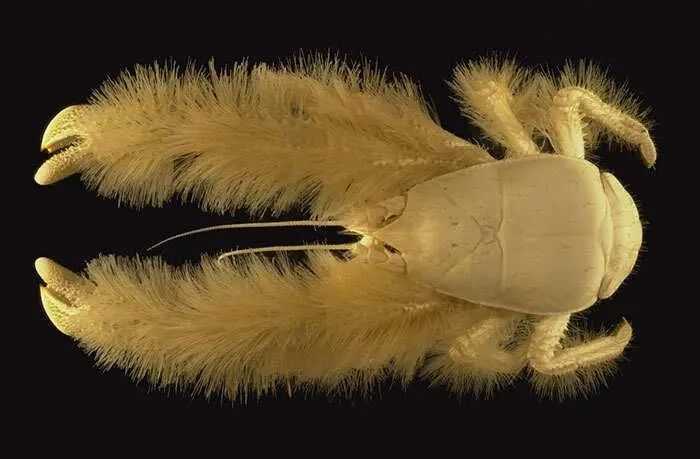
Also known as the Hoff crab, the yeti crab (Kiwa hirsuta) has captivated marine biologists with its most striking feature: legs and claws entirely covered in dense, golden bristles. Discovered in 2005 near hydrothermal vents in the South Pacific, this crustacean belongs to the family Kiwidae and thrives in some of the ocean’s most extreme environments.
-
Golden Bristles as a Survival Tool
The crab’s hairy appendages are not fur but specialized setae (bristles) that host symbiotic bacteria. These bacteria convert toxic chemicals from hydrothermal vents—such as hydrogen sulfide—into energy through chemosynthesis, forming the base of the crab’s food chain. The golden color may result from mineral deposits on the setae, providing both protection and a surface for bacterial growth.
-
Blind and Bald in the Dark
Lacking functional eyes, the yeti crab relies on sensory hairs to navigate the pitch-black depths. Its flattened body and strong claws allow it to cling to vent chimneys, while its feathery gills extract oxygen from superheated, mineral-rich water. Growing up to 15 centimeters, it is one of the few animals capable of surviving near 400°C vent plumes.
-
A Unique Symbiotic Relationship
The crab actively tends to its bacterial gardens, waving its legs to circulate nutrient-rich water and grooming the setae to remove debris. In return, it feeds on the bacteria, making it a rare example of a crustacean relying primarily on chemosynthesis rather than predation or scavenging.
-
Reproduction and Distribution
Females carry eggs beneath their abdomens, protecting them from toxic vent fluids. The species has been found in multiple vent fields, including the East Scotia Ridge and the Mariana Trench, though its exact distribution remains unclear due to the inaccessibility of its habitat.
The yeti crab’s discovery revolutionized understanding of deep-sea ecosystems, proving life can thrive in environments once thought uninhabitable. Its symbiotic relationship with bacteria offers insights into astrobiology, inspiring theories about life on other planets with extreme conditions.
While not currently endangered, the species faces potential threats from deep-sea mining, which could destroy hydrothermal vent habitats. Scientists advocate for the establishment of marine protected areas around vent fields, highlighting the need to preserve these unique ecosystems before their secrets are lost.
In the pitch-black depths where sunlight never reaches, the yeti crab stands as a testament to nature’s ability to craft life in the most unlikely places. Its golden-haired form, glowing in the submarine darkness, reminds humanity that the ocean’s mysteries are far from fully explored—and that every discovery holds lessons for understanding the limits of life itself.