The Brazilian Four-Tubercled Treehopper: Nature's Bizarre 'Helicopter' Insect


Insect Information
The Brazilian Four-Tubercled Treehopper: Nature's Bizarre 'Helicopter' Insect

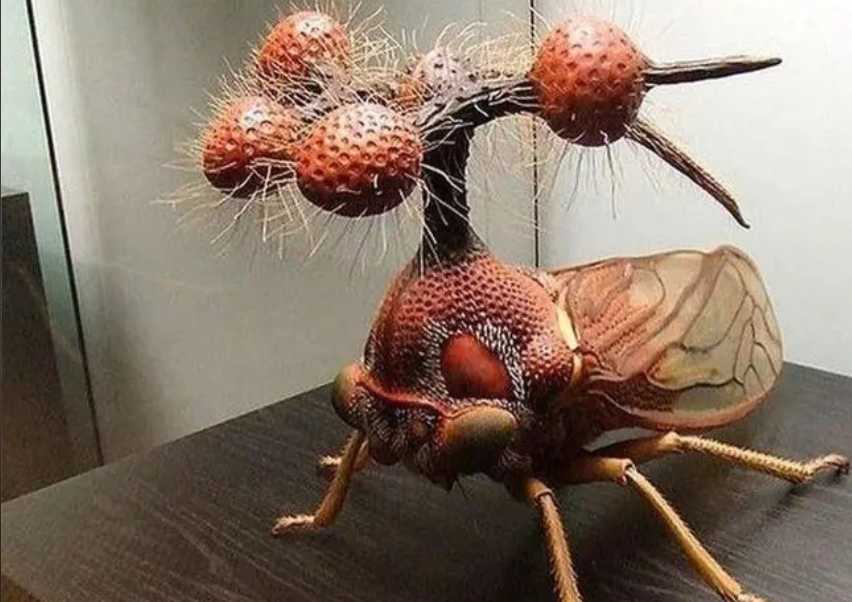
Deep in Brazil’s rainforests, a tiny insect has evolved an otherworldly appearance: the four-tubercled treehopper (Bocydium globulare), whose head is crowned with bulbous, hairy projections resembling a miniature helicopter. This remarkable bug, part of the family Membracidae, showcases nature’s most whimsical adaptation, blending survival strategy with an almost sci-fi aesthetic.


A Head Like a Flying Machine
The treehopper’s most striking feature is its pronotum—the plate covering its thorax—modified into four spherical, 毛状 (hairy) tubercles that sprout from its head. These bulbous growths, sometimes compared to "fuzzy helicopter blades," are actually extensions of its exoskeleton, covered in fine setae (hairs) that give them a soft texture. While their exact function remains debated, scientists suspect the tubercles serve as a form of deceptive mimicry, confusing predators by distorting the insect’s true shape. When perched on branches, the treehopper’s silhouette resembles a bird dropping or a strange plant gall, deterring would-be attackers.


Evolutionary Wonder and Ecological Role
Measuring just 5–8 mm, this treehopper feeds on plant sap, using its piercing mouthparts to tap into stems. Like other treehoppers, it may secrete honeydew, attracting ants that protect it in a mutualistic relationship. Native to the Atlantic Forest and Cerrado biomes, the species faces threats from deforestation, though its cryptic lifestyle makes it hard to study. For entomologists, the four-tubercled treehopper is a testament to evolution’s quirky creativity—proof that even in the smallest creatures, natural selection can produce forms as bizarre as they are effective. As researchers continue to unravel the mystery of its "helicopter head," the insect stands as a living reminder that the natural world is full of wonders waiting to be discovered.

Latest Stories
Feline News1 minute readThe Minskin, a relatively new feline breed, has been gaining popularity among pet lovers for its distinctive appearance and amiable temperament. Developed in the United States in the 1990s by breeder Paul McSorley, this breed results from a deliberate crossbreeding program combining the Sphynx’s hairless gene, the Munchkin’s short-legged trait, and the Devon Rex’s curly coat gene to enhance genetic health.
Sports News1 minute readWith exactly three years to go until its July 14, 2028 opening, the LA Organizing Committee released its first day-by-day event schedule on Monday (July 14). While adjustments may follow, the core framework is now set, covering 50 sports or disciplines.
Social News1 minute readAcross the globe, several nations grapple with extreme poverty, marked by abysmal GDP per capita, crumbling infrastructure, and dire living conditions. These countries, trapped in cycles of conflict, instability, and resource exploitation, struggle to meet even basic needs of their populations.
Sports News1 minute readThe Athletics Integrity Unit (AIU) released its annual report on Monday, showing an escalation in its work. The body handled 100 international-level cases in 2024, with a key focus on the Olympic Games—97% of finalists underwent pre-competition testing.
Industry News2 minute readThe Defense Counterintelligence and Security Agency (DCSA) on July 9 released its 2025-2030 IT Strategic Plan, outlining six core objectives to modernize defense cybersecurity, enhance data-driven decision-making, and foster collaboration with industry and academia. The initiative aims to create a secure digital ecosystem aligned with the Pentagon’s broader digital transformation goals, particularly supporting the Department of Defense’s (DoD) Chief Digital and AI Office (CDAO) in advancing AI integration and governance .
Feline News1 minute readThe Munchkin Longhair, with its signature short legs and silky, flowing fur, has captivated cat lovers globally. Originating in the U.S. during the 1980s, this breed emerged from crossing Munchkin cats (with naturally short legs due to a genetic mutation) with long-haired felines, refining their luxurious coats through selective breeding. While The International Cat Association (TICA) recognized the Munchkin breed in 2003, standards for the long-haired variant remain evolving, and some associations reject recognition due to health concerns.
Feline News1 minute readThe Ukrainian Levkoy, a distinctive cat breed hailing from Ukraine, has garnered attention worldwide for its striking appearance and gentle demeanor. Developed through selective breeding efforts in the early 2000s, this breed is a result of crossing the Donskoy (a hairless breed) with the Scottish Fold, resulting in a one-of-a-kind combination of traits.